Your first AI workflow should be boring.
A practical scorecard for choosing your first AI project, measuring the baseline and deciding whether it earned the next step.
Read the guideFANDS FIELD GUIDE 004 · 6 MIN READ
Agents are exciting. Workflows are dependable. Most small businesses need the second before the first.
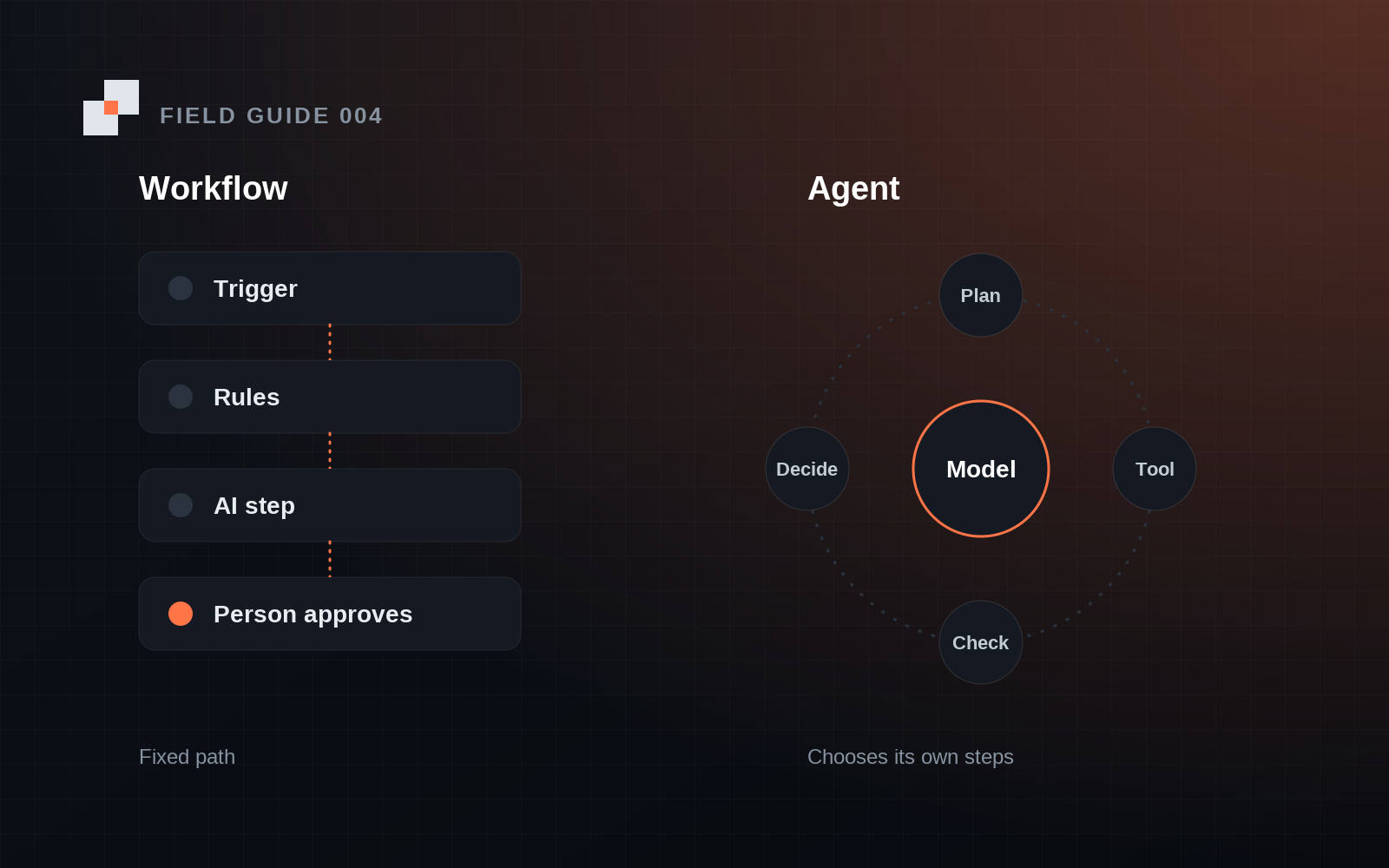
"Agent" has become the word for any software that uses AI. For a business owner, that makes it hard to know what to buy. The practical question is simpler: should the system follow a fixed path, or decide its own steps?
Anthropic's engineering guide “Building effective agents” draws a useful line. Workflows run through predefined paths: step one, then step two, then step three, with AI used inside some of the steps. Agents decide their own steps, use tools and loop until the job is done. Workflows are predictable. Agents are flexible. The guide itself recommends starting with the simplest approach and adding autonomy only when it earns its place.
| Workflow | Agent | |
|---|---|---|
| Path | Fixed, designed in advance | Chosen by the model as it goes |
| Predictability | High | Lower |
| Cost and speed | Low and fast | Higher and slower |
| Good for | Repeatable tasks with clear rules | Open-ended tasks with changing steps |
| Testing | Easy to test and monitor | Harder to test, needs more guardrails |
| Example | Read an invoice, match it to a purchase order, draft the entry | Research a prospect across the web and write a briefing |
The best designs often put a small amount of AI inside a workflow. An inbound email arrives, a workflow routes it, AI reads and classifies it, a rule decides the next step, AI drafts a reply, and a person approves. The agent-like part is narrow, and the rest is predictable.
A quote request arrives by email. A workflow can route it, log it in the CRM and send a confirmation every time. AI can read the message, pull out the job type and address, and draft a reply. Together they are one design: fixed steps with a small, bounded AI step inside. An agent would only be needed if the task became open-ended, for example researching an unfamiliar commercial client across several sources before writing a proposal.
A research assistant that gathers information, or an internal assistant that answers questions from your own documents, are typical examples.
More freedom means more variation. Agents tend to use more compute, take longer and fail in less predictable ways. That is acceptable when the task needs it, and wasteful when it does not.
Start with a workflow. Add an AI step where judgment helps. Make it an agent only when the fixed path stops working and you can measure the difference.
We begin with the process, not the technology. For most small-business problems, such as invoices, lead follow-up and onboarding, a well-built workflow with AI steps and a person approving is the right answer. When a task truly needs an agent, we build one with limits, logging and a clear way to stop it.
Explore our AI assistants and agents
Published by Fands, November 2026. Descriptions of workflows and agents follow public guidance from Anthropic and vary between teams.
Automation, or a workflow, follows steps you defined in advance. An agent decides its own steps, uses tools and loops until the job is done, which makes it more flexible and less predictable.
Not by default. Agents suit open-ended tasks with a clear way to check the result. For repeatable work with clear rules, a workflow is usually cheaper, faster and easier to trust.
Yes, and it is the safer path. Build the fixed process first, measure it, and add agent-like behavior only to the steps where a fixed rule keeps failing.
More field notes on putting AI to work in a small business.
A practical scorecard for choosing your first AI project, measuring the baseline and deciding whether it earned the next step.
Read the guideWhy the speed of your first reply decides who gets the job, and a practical plan to answer every new lead in minutes.
Read the guideA baseline, one metric and a monthly review. A simple method for proving that an AI project paid for itself.
Read the guideTell us the process, and we will tell you whether it needs a workflow or an agent.
Get a recommendation