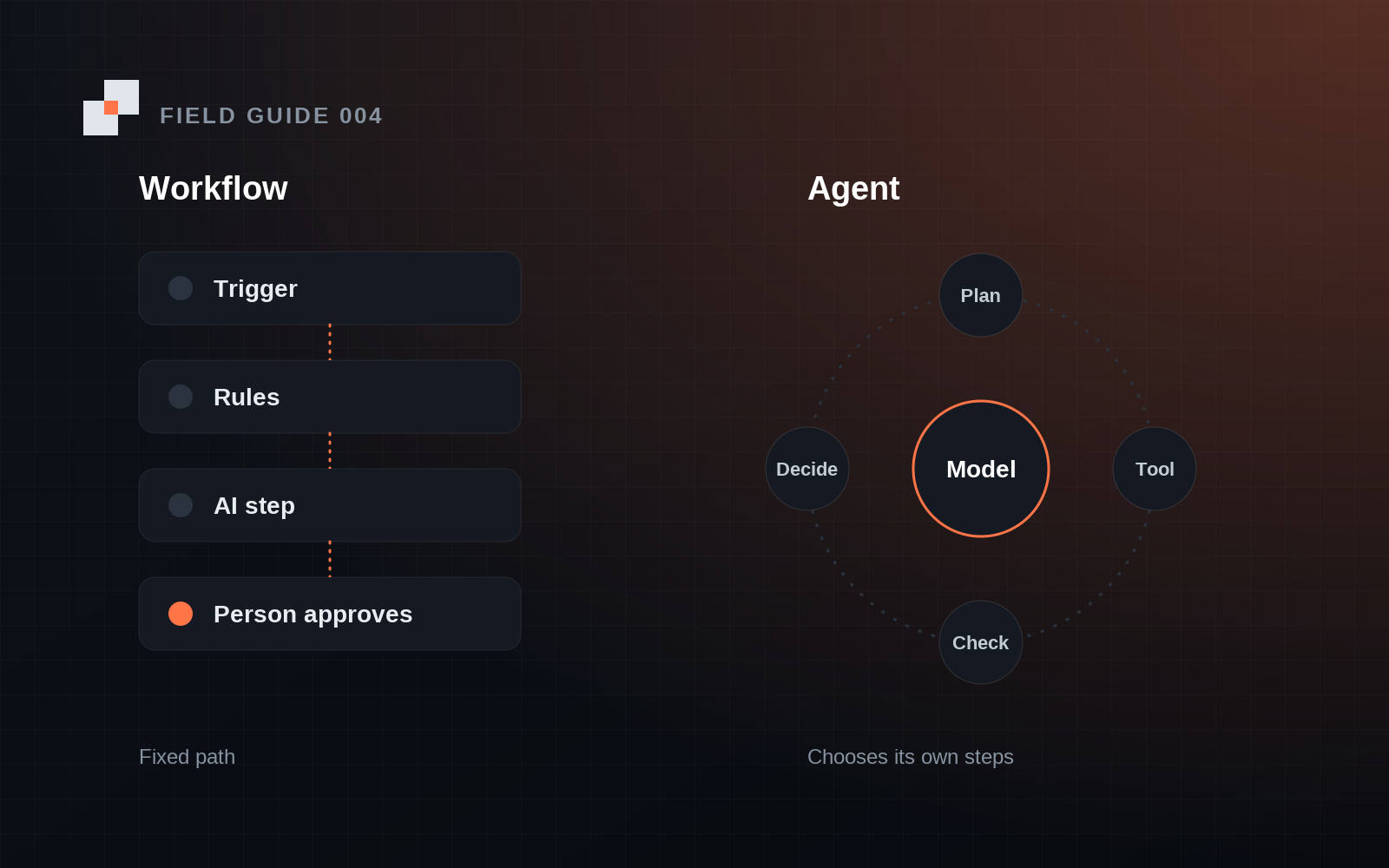
Workflow or AI agent? Pick the simplest thing that works.
Not every problem needs an agent. A plain-English guide to choosing between a workflow and an agent, and why simple usually wins.
Read the guideFANDS FIELD GUIDE 001 · 7 MIN READ
Start with the handoff your team knows too well. Then make the improvement visible.
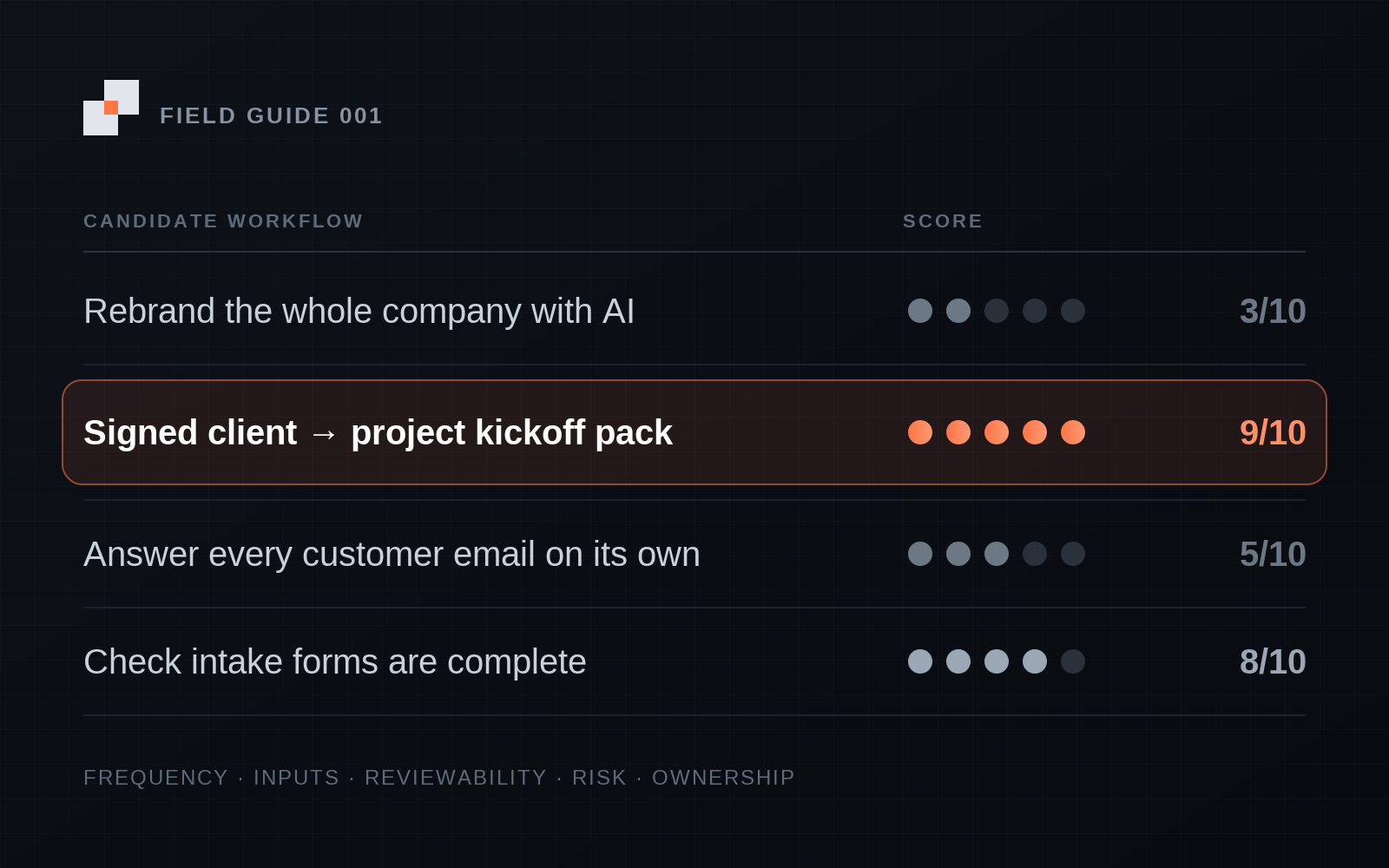
The best place to begin is often the work nobody puts in a presentation: copying an approved brief into a project record, checking whether an intake form is complete, or assembling the same kickoff pack for the tenth time.
These tasks have something a big “AI transformation” idea often lacks: a clear beginning, a recognizable output, and a person who can tell whether the result is useful.
List five moments when work moves between people or tools. For each, record what triggers it, what the next person needs, who owns it, and how often it happens. Start with the queue that causes repeated chasing.
For a consulting firm, that might be the gap between a signed scope and an approved project kickoff. The input is a known document. The output is a reviewed project record, a task list, and a kickoff pack.
Give each criterion a score from 0 to 2. This is a prioritization aid, not a validated prediction of success.
| Criterion | 0 points | 2 points |
|---|---|---|
| Frequency | Rare or unpredictable | Repeated every week |
| Input readiness | Missing or inaccessible | Available and consistent |
| Reviewability | Hard to verify | A person can check quickly |
| Risk | Consequential, irreversible | Bounded and reversible |
| Ownership | Nobody owns the process | A named process owner |
Use 1 point for the middle ground. Investigate the highest score first. A zero on ownership or risk is a reason to pause regardless of the total.
For a proposed two-week baseline, log every eligible handoff. Track the number of cases, hands-on minutes, elapsed time, missing information, and rework. Use a longer period if volume is too low or seasonality would distort the comparison.
Keep handling time and cycle time separate. Fifteen minutes of work can sit in a queue for three days. A system may improve one measure without improving the other.
Ask AI to extract, summarize, classify, or draft from approved sources. Put deterministic rules around required fields, access, and routing. Keep a person responsible for consequential approval.
The system needs an exception path. If a brief is incomplete, contradictory, or low confidence, it should stop and route the case to its owner. It should never quietly invent a missing budget or promise a delivery date.
Build a test set that includes incomplete documents, duplicates, unexpected formats, permission failures, and conflicting instructions inside source text. Verify that the workflow does not treat document content as permission to take an action.
A successful happy path is necessary. Reliable failure handling is what makes the workflow usable.
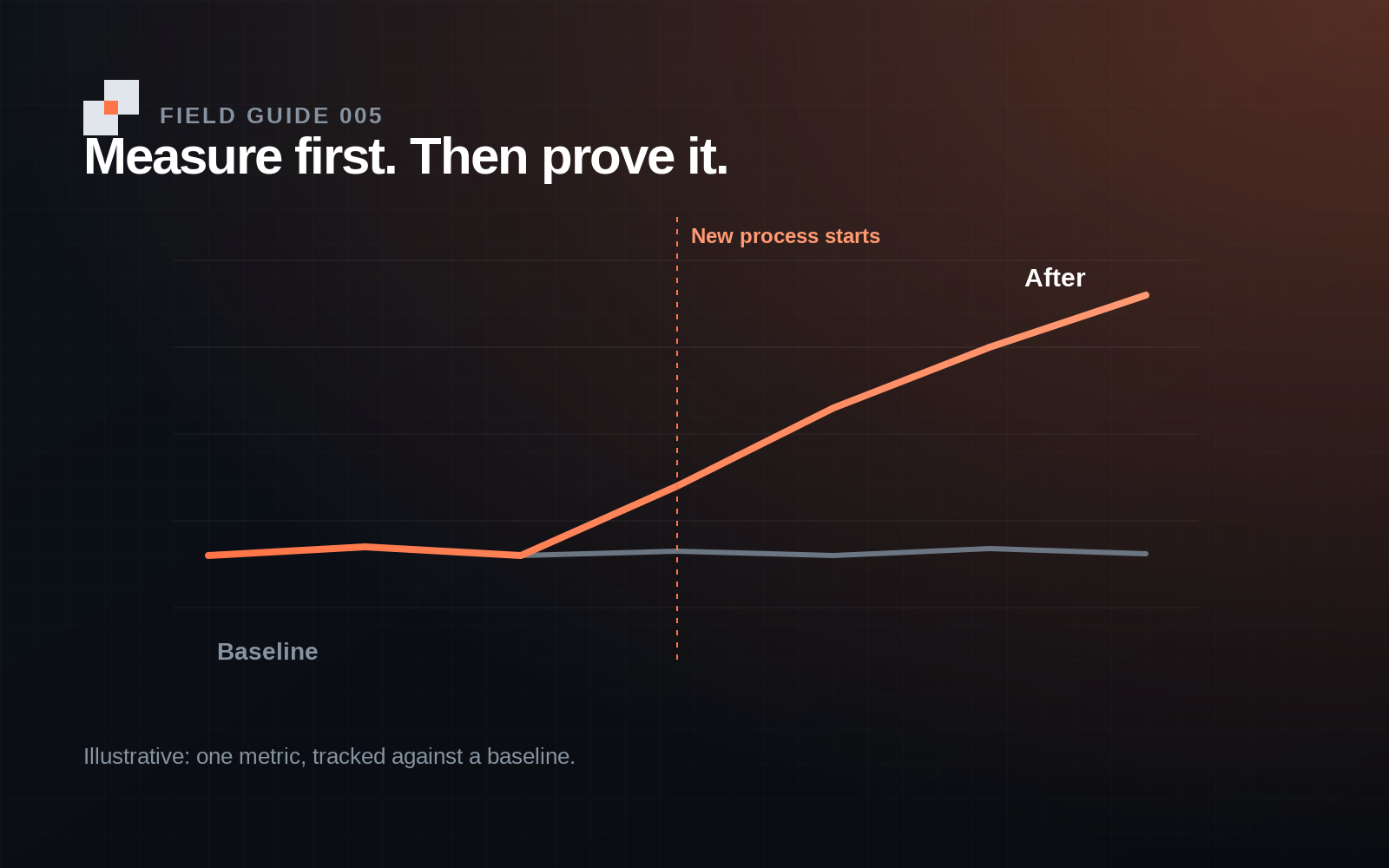
Compare similar cases before and after deployment. Include time spent reviewing outputs, fixing mistakes, and maintaining the system. Report the sample size and the observation period alongside the result.
80 handoffs per month × 30 minutes each = 40 hours of manual work. An assumed 30% reduction suggests 12 hours of gross capacity. Subtract additional review and maintenance before describing the net benefit. Reclaimed time becomes cash savings only when a real cost changes.
Agree the decision rule before launch: what quality must be maintained, what improvement matters, and which failures mean rollback. At the review, choose to expand, revise, maintain, or stop.
Your first workflow does not need to transform the company. It needs to prove you can make one important piece of work measurably better.
Tell us which handoff you would start with
Published by Fands, October 2026. Examples and thresholds are illustrative; no client outcome is claimed.
A recurring handoff between people or tools that happens every week, has a clear input and output, and is easy for a person to review, such as turning an approved brief into a project record.
Two weeks is a reasonable start. Use a longer period if volume is low or seasonality would distort the comparison.
For a first workflow, no. Let AI extract, summarise, classify or draft from approved sources and keep a person responsible for consequential approval.
More field notes on putting AI to work in a small business.
Not every problem needs an agent. A plain-English guide to choosing between a workflow and an agent, and why simple usually wins.
Read the guideA baseline, one metric and a monthly review. A simple method for proving that an AI project paid for itself.
Read the guideWhy the speed of your first reply decides who gets the job, and a practical plan to answer every new lead in minutes.
Read the guideTell us which handoff you would start with.
Request a workflow review